
Enfield’s New Local Plan: What’s Changing?
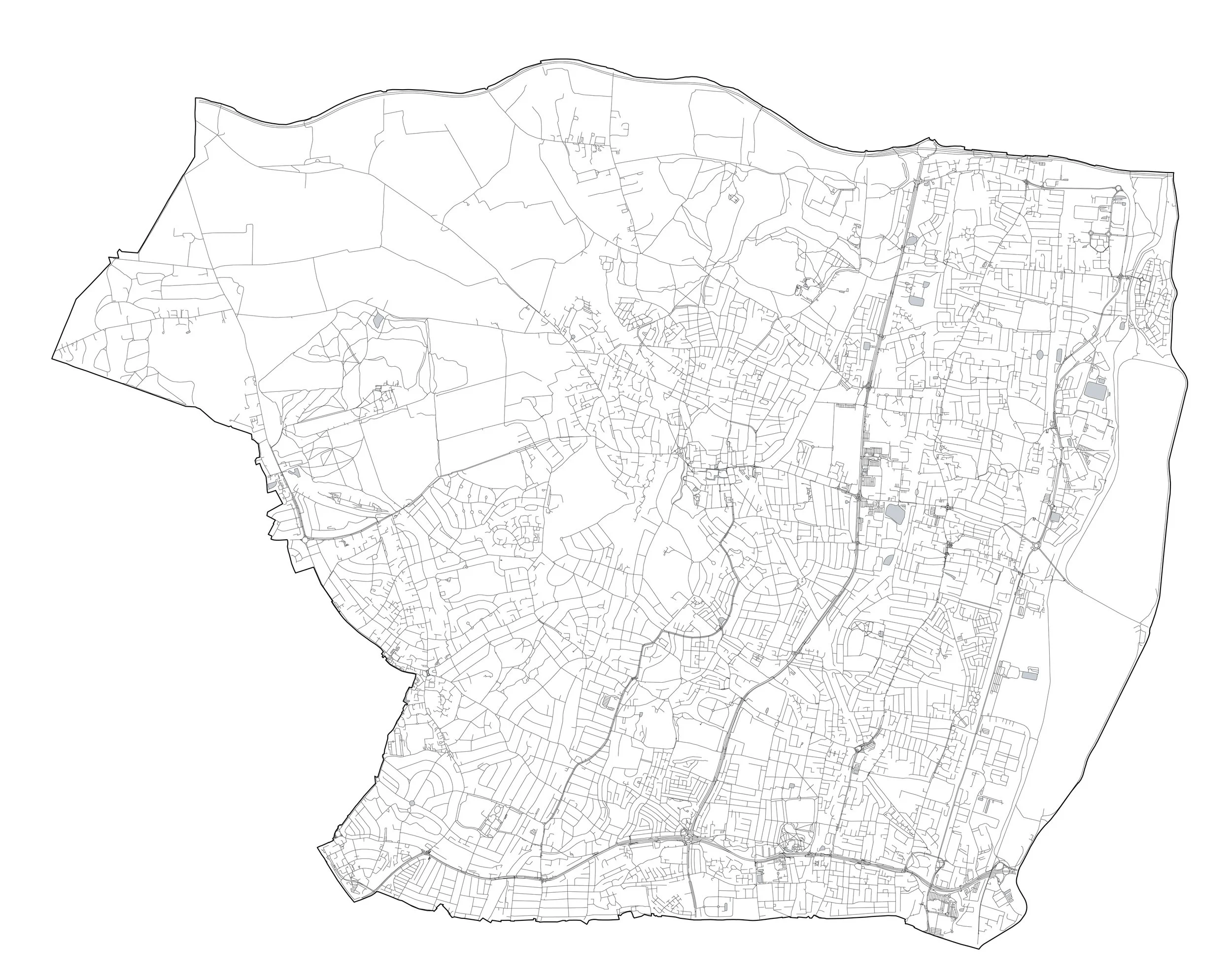
Map of the London Borough of Enfield
When we first wrote about Enfield's new Local Plan, it was working through public examination. A lot has happened since. The plan has now completed its hearings, the Government has overlaid a 'new town' on two of its largest sites, and — following the May 2026 local elections — a different administration is in charge of seeing it through. This is where the plan stands, what it proposes to change, and what it means if you are planning a project in the borough.
Where the plan stands now (June 2026)
Enfield submitted its new Local Plan to the Planning Inspectorate in August 2024. Independent examination by inspector Steven Lee ran across 27 hearing days in three stages through 2025 — Stage 1 (January, housing targets and Green Belt), Stage 2 (June–August, site allocations) and Stage 3 (October–November, policies including tall buildings, the economy and climate). The hearings concluded in November 2025, followed by a short set of focused sessions in March 2026.
The plan is now at the main modifications stage: the council and inspector agree the changes needed to make the plan "sound," after which there will be a final round of public consultation on those modifications. The inspector has said his preference is then to proceed straight to his report, though he may hold further hearings if the consultation raises new issues. After his report, the council can formally adopt the plan, which looks ahead to 2041 and will replace the 2010 Core Strategy and 2014 Development Management Document (DMD).
In planning terms, the emerging plan now carries more weight than it did a year ago — it is past examination and nearing adoption — but it is not yet adopted, and as set out below its final shape is genuinely uncertain. Until adoption, applications are still determined under the adopted Core Strategy and DMD.
What the plan proposes to change
The direction of travel is a decisive shift from the existing "regeneration within set corridors, protect the Green Belt" framework toward much higher growth — including, for the first time, Green Belt release.
1. Housing targets and scale. The 2010 Core Strategy planned roughly 11,000 homes over 15–20 years (around 560–800 a year), concentrated on brownfield land in the south and east. The new plan is driven by the London Plan (2021) requirement of about 1,876 homes a year — more than doubling historic delivery — and can no longer be met on brownfield alone.
2. Green Belt release. The most significant change. The plan proposes releasing Green Belt land, with the council seeking to allocate around 9,651 homes across four Green Belt sites — Hadley Wood, a site off the A10, Crews Hill, and 'Chase Park' (Vicarage Farm). During examination the council itself acknowledged this would cause "high harm" to the Green Belt, and the Mayor of London signalled a U-turn to support Green Belt building in Enfield — a notable shift from longstanding City Hall policy. This remains the most contested element locally.
3. The Government 'new town' overlay. In March 2026 the Government confirmed Crews Hill (with Chase Park) as one of seven national 'new towns', earmarked for at least 21,000 homes — more than double what the Local Plan itself allocates for those sites. The Government told councils to continue their plan-making regardless, on the basis that "nothing is set in stone," leaving the Local Plan and the new-town programme to be reconciled.
4. Meridian Water. Long the borough's flagship regeneration site, Meridian Water's ambition has risen from the 5,000 homes envisaged in 2010 toward a 10,000-home aspiration — though during examination the council conceded it could currently only allocate around 7,400, and that a strategic water main presents a further constraint. It remains the borough's primary engine for housing delivery.
5. Industrial intensification. The plan keeps protecting industrial capacity but embraces intensification and co-location — multi-storey logistics and, in places, residential above industrial ("beds on sheds"), particularly around Meridian Water and Edmonton Leeside, in line with London Plan Policy E7.
6. Tall buildings and town centres. The plan takes a more permissive approach to tall buildings, designating zones (town centres, Meridian Water, transport hubs) where height is encouraged to optimise capacity, and pushes higher-density housing into town centres — including Enfield Town — to support struggling high streets.
The political wildcard
The plan's trajectory was complicated by the May 2026 local elections, after which Enfield Council moved to no overall control, with a minority Conservative administration taking office at the end of May. Its first major planning act followed within days: the new council leader wrote to the housing minister formally withdrawing Enfield from the Government's New Towns process, citing an electoral mandate to protect the Green Belt. The Mayor of London's office responded that the Crews Hill new town remains "alive" and that City Hall will continue to develop the project — setting up a direct stand-off between borough and regional government over the same 884 hectares.
Two careful distinctions for anyone tracking this. First, the withdrawal concerns the new-town designation, not the Local Plan itself — the plan's own Green Belt allocations (around 9,651 homes across the four sites) remain in the submitted plan now being finalised through main modifications. Second, a Labour-drafted plan that leans heavily on Green Belt release is now being carried forward by an administration elected on the opposite platform, at the precise moment the main modifications are being settled. Both make the final content of the plan — especially the Green Belt allocations — less certain than a post-examination plan would normally be. We will update this piece as the position resolves.
What it means for HMO and conversion applicants
One point specific to our area of work. The version of the plan that went to examination did not contain a dedicated policy on HMOs or residential conversions — a notable gap for a borough with a borough-wide Article 4 Direction. In January 2026 the council acknowledged this and asked the inspector to allow an HMO policy to be added through the main modifications, with focused hearings held on 18–19 March 2026. Whether, and in what form, that policy survives into the adopted plan is still open.
The takeaway for landlords and developers: until the new plan is adopted, HMO and conversion applications in Enfield are still decided under the adopted DMD — principally Policy DMD 5 and its concentration rules — alongside the London Plan. But a new HMO policy could change the tests, so the position is worth checking before you commit. We set out the current requirements in full in our HMO planning permission in Enfield checklist.
What happens next
In sequence: main modifications agreed → final public consultation on those modifications → inspector's report → council adoption. On the current trajectory that points to adoption within the plan period to 2041, but the change of administration and the new-town overlay make the timing and final content harder to call than usual. As the plan moves closer to adoption its weight in decision-making rises — which is exactly why it pays to factor the emerging policy into any Enfield scheme now, not after it lands.
If you are weighing up a project in Enfield — a conversion, an HMO, an extension or a larger site — contact us and we will tell you how both the adopted and the emerging policy bear on it.
Status verified on 5 June 2026 against Enfield Council planning pages, the Planning Inspectorate examination record, and contemporaneous reporting (including the council's withdrawal from the New Towns process, late May 2026). The new Local Plan was not adopted at the date of writing; confirm the current position before relying on it.
