
HMO Conversion in London: The Complete 2026 Planning Guide
Converting a house into a House in Multiple Occupation (HMO) is one of the few moves in London property that can transform the income and value of the same building — and one of the easiest to get wrong. The rules are not London-wide: they change at borough boundaries, they have changed fast in the last eighteen months, and the most expensive mistakes happen before a planning application is ever made.
This is the complete 2026 guide: whether you need planning permission, what it costs, what standards decide approval, and how the regulatory map is moving. Every borough position stated here was verified against council sources in June 2026 — worth saying, because much of what ranks on this subject is out of date.
June 2026 · Bashkal Consultancy · 12 min read
Last verified: 8 June 2026 against council and GOV.UK sources.
First principles: what counts as an HMO
A small HMO (Use Class C4) is a dwelling shared by 3–6 unrelated people who share facilities such as a kitchen or bathroom. A single household (a family, a couple) is Class C3. Under national permitted development rules (GPDO Class L), you can switch between C3 and C4 without planning permission — unless the borough has removed that right with an Article 4 Direction.
Above six occupants the property becomes a large (sui generis) HMO, and that change of use always needs planning permission, in every borough, Article 4 or not. This is the single most misunderstood line in HMO conversations.
The second most misunderstood: planning and licensing are different regimes. An HMO licence does not grant or imply planning permission, and being "Article 4-free" never means "no regulation" — mandatory licensing applies across England to HMOs of 5+ people, and most London boroughs now layer additional or selective licensing on top.
The Article 4 question — London's real HMO map
Whether your conversion needs planning permission comes down to one check: does the borough have a C3→C4 Article 4 Direction covering your property? As of June 2026, 22 of London's 33 planning authorities — two-thirds — do, in whole or in part. The map splits three ways: 17 borough-wide (permission always required), 5 area-based (it depends on the address), and 11 Article 4-free (permitted development still applies).
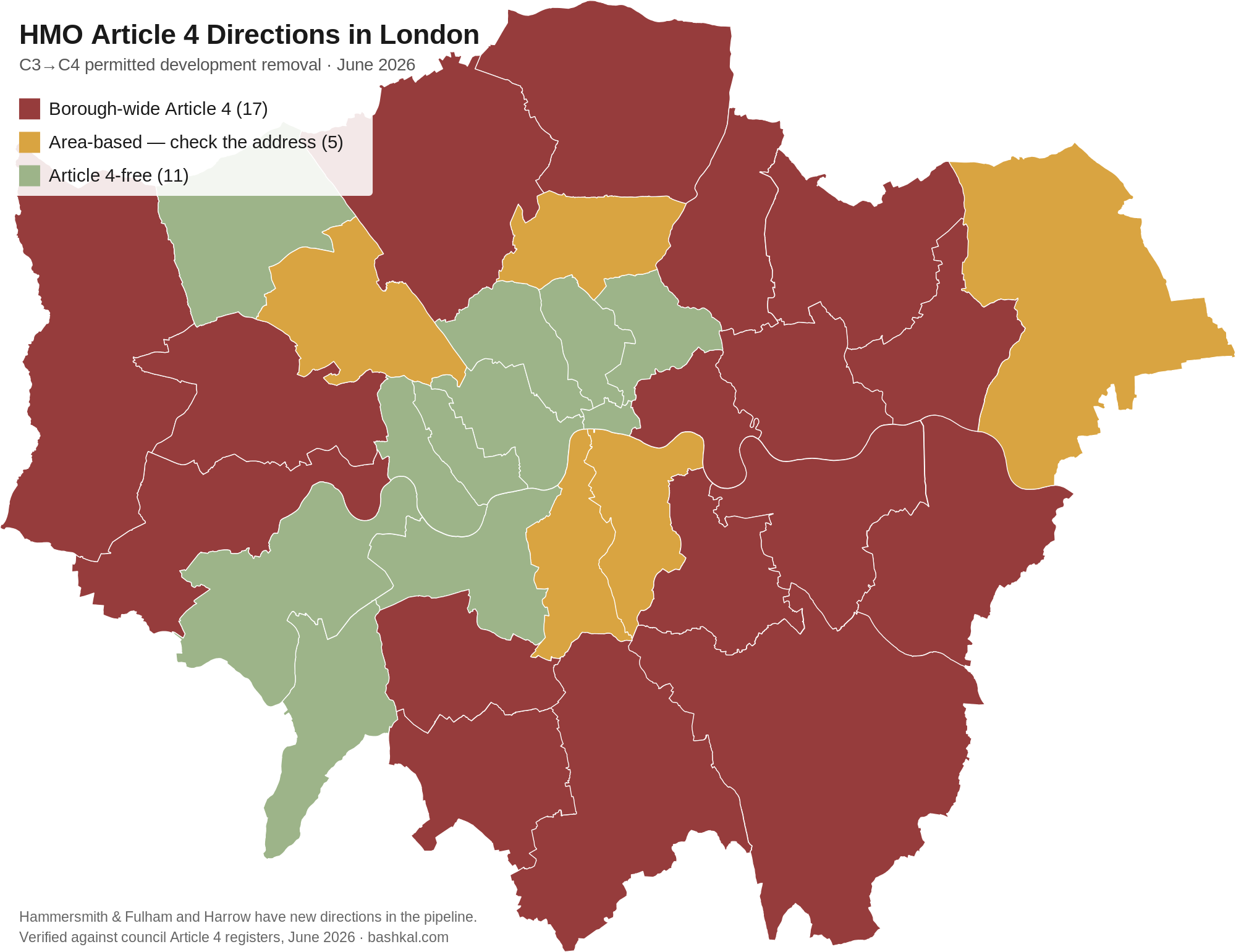
| Borough-wide — planning always required | Area-based — depends on the address | Article 4-free — PD still applies |
|---|---|---|
| Barking & Dagenham | Brent (Growth Area/Park Royal carve-outs) | Camden |
| Barnet | Haringey (most eastern wards) | Hackney |
| Bexley | Havering (4 wards; elsewhere not detached) | Hammersmith & Fulham (direction approved — coming) |
| Bromley | Lambeth (2 Streatham wards) | Harrow (immediate direction in pipeline) |
| Croydon | Southwark (2 streets) | Islington |
| Ealing (excl. Perivale/OPDC) | Kensington & Chelsea | |
| Enfield | Kingston upon Thames | |
| Greenwich | Richmond upon Thames | |
| Hillingdon | Wandsworth | |
| Hounslow | Westminster | |
| Lewisham | City of London (negligible) | |
| Merton (awaiting final confirmation) | ||
| Newham | ||
| Redbridge | ||
| Sutton | ||
| Tower Hamlets | ||
| Waltham Forest |
Borough planning portals, verified against council sources June 2026. Always confirm the current position for a specific address — Article 4 coverage is expanding.
In the borough-wide boroughs the work is a full change of use application — assessed on concentration/clustering policies, accommodation standards, amenity and parking. Our Enfield checklist shows exactly what that assessment looks like. In the area-based boroughs the first step is always a site-specific check against the council's Article 4 map — one street can sit on the opposite side of the line from the next; our Haringey checklist walks through a split-boundary borough. In the Article 4-free boroughs a small HMO conversion needs no planning application — see our Camden and Islington guides — but two big caveats follow.
First, protect the position before you rely on it. A Lawful Development Certificate (Proposed) is the formal confirmation that your specific conversion is lawful permitted development — inexpensive insurance before committing to a purchase, and proof of lawful use forever after.
Second, the free list is shrinking. Sutton went borough-wide in February 2025, Lambeth designated its Streatham wards in August 2025, Ealing went borough-wide in November 2025, Hillingdon in December 2025, Merton completed its coverage in March 2026 — and Hammersmith & Fulham has approved a borough-wide direction (expected to take effect around a year after it is made), while Harrow has an immediate direction in the pipeline that could arrive with no notice period. Landlords already operating C4 HMOs in newly-designated boroughs should secure an LDC (Existing) to evidence their established use before enforcement questions ever arise.
For the market data behind all this — the 23% contraction in London's HMO stock since 2018, the yield arithmetic, the landlord exodus and who is replacing them — see our research article, HMO Conversion Demand Is Accelerating.
What decides approval in an Article 4 borough
Every borough writes its own policy, but London HMO applications are decided on a consistent set of tests:
Concentration / clustering. Most boroughs cap HMO density — Enfield refuses where conversions would exceed 20% of a road or break a 1-in-5 run of houses; Barking & Dagenham uses 10% per road; Haringey applies a qualitative "cumulative impact" test and only supports conversion of houses over 120 m². Check the specific numbers before you buy, not after.
Accommodation quality. Room sizes and amenity standards, set at three levels: the national mandatory HMO minimums (6.51 m² for one adult, 10.22 m² for two, 4.64 m² for a child under 10 — no smaller room may be used for sleeping); the London Plan quality standards (Policy D6); and the borough's own HMO standards, which are often higher — Haringey requires 10 m²+ for a single letting, Enfield sets its own kitchen and communal-space figures.
Amenity and neighbour impact — noise and stacking of rooms, refuse storage that doesn't blight the street, cycle parking, and demonstrating the conversion won't tip on-street parking over the edge.
Fire safety — designed in from the start under London Plan Policy D12, with BS 9991:2024 the operative code (sole version for new design adoption from 30 September 2026).
Licensing then runs in parallel: mandatory licensing for 5+ occupants everywhere, additional licensing schemes in a growing majority of boroughs (typical fees £900–£2,000 per property), and per-room structures in some (Lambeth charges £550/room). Budget for both consents from day one.
What it costs — and what it's worth
The statutory planning fee for a C3→C4 change of use is £610 from 1 April 2026 (the "other changes of use" flat fee — C4 HMOs are not separate dwellings, so the per-dwelling rate does not apply). Submit through the Planning Portal — as almost all applications are — and the Portal's service charge of £75.83 + VAT brings the total payable to £701. An LDC (Proposed) runs at half the equivalent application fee; professional fees for a full London HMO submission — drawings, planning statement, case management — typically sit in the £1,200–£4,000 band depending on scope and complexity. (Note: there is no longer a "free resubmission" — the free-go was abolished in England on 6 December 2023, so a revised application pays the full fee again. A planning appeal to the Inspectorate remains free.)
Against the project economics, those are transaction costs. A well-executed London HMO conversion typically delivers 2–3× the rent of the same building let single, with capital uplift of 20%+ on the converted asset; title-split flat conversions run at 25–35%. On a scheme capturing £100,000–£300,000 of value uplift, the entire planning-and-advisory layer is 1–3% of the value created. The expensive version of this project is not the one with professional fees — it's the one bought in the wrong borough, designed to the wrong room sizes, or enforced against for want of a certificate.
The 2026 changes to have on your radar
Renters' Rights Act Phase 1 — in force since 1 May 2026. Section 21 abolished; all tenancies now periodic; possession via Section 8 grounds (including Ground 4A for student HMOs, allowing summer possession for re-letting). Five tenants now means five individual tenancy relationships — management quality is the moat.
Statutory fees indexed — £610 COU fee from 1 April 2026, rising with CPI annually.
BS 9991:2024 — sole usable version for new design adoption from 30 September 2026.
The Article 4 map keeps tightening — H&F and Harrow are the next likely flips; Merton's confirmation decision lands this summer.
Licensing expansion — the December 2024 General Approval removed the central sign-off threshold, and borough-wide additional schemes keep arriving (Camden renewed December 2025, Islington February 2026, Hackney May 2026).
How to run the decision
- Borough and address check. Which of the three Article 4 buckets are you in — borough-wide, area-based or Article 4-free? For area-based boroughs, check the council map for the exact address.
- Occupancy check. 3–6 sharers is a small C4 HMO; 7+ is sui generis and always needs a full application, anywhere.
- Feasibility against the borough's tests. Concentration/clustering rules, minimum property size, room standards, the licensing layer and fees.
- Secure the right consent. Full change-of-use application in Article 4 areas; LDC (Proposed) where PD applies; LDC (Existing) for established uses in newly-designated boroughs; and the HMO licence in parallel.
- Design to the higher standard. Wherever borough licensing standards exceed the planning minimums, design to the licensing figure from day one.
- Check the works separately. Conservation-area Article 4s, basement controls and Building Regulations (fire separation, escape, sound) apply to the building work independently of the use change.
The single fact that decides an HMO conversion in London is the borough — and that map is moving one way. Two-thirds of authorities now have an Article 4, five boroughs flipped in eighteen months, and Hammersmith & Fulham and Harrow are next. The expensive mistakes are all made before submission: the wrong borough, the wrong room sizes, or a property that never qualified for PD in the first place. Run the borough check first, design to the higher of the planning and licensing standards, and protect the position with a certificate before you commit.
Send us the postcode and we'll tell you what's possible. 020 3740 7041 · info@bashkal.com
Work with Bashkal
Bashkal specialises in residential conversions across London — HMO change of use, flat conversions and lawful development certificates — and we run exactly this sequence for landlords and developers: borough check, feasibility, compliant drawings, submission and licensing coordination.
Call: 020 3740 7041
Email: info@bashkal.com
The borough cluster:Camden · Islington · Hackney · Haringey · Enfield · Waltham Forest.
The consents:Lawful Development Certificate (Proposed) · Certificate of Lawfulness (Existing Use).
The market data: our Research piece on why HMO conversion demand is accelerating.
Frequently asked questions
Do I need planning permission to convert a house to an HMO in London? It depends on the borough. A small HMO (C4, 3–6 sharers) needs planning permission in the 22 of 33 authorities with a C3→C4 Article 4 Direction. In the 11 Article 4-free boroughs the change is permitted development — confirm it with an LDC (Proposed). An HMO of 7 or more people always needs permission, everywhere.
Which London boroughs have Article 4 for HMOs? As of June 2026, 22 of 33 do: 17 borough-wide (permission always required), and 5 area-based (it depends on the address). Eleven boroughs remain Article 4-free, where permitted development still applies. The map is tightening — Hammersmith & Fulham and Harrow are the next likely flips — so always confirm the current position for a specific address.
How much does an HMO planning application cost in 2026? The statutory C3→C4 change-of-use fee is £610 from 1 April 2026, rising to about £701 with the Planning Portal service charge (£75.83 + VAT). An LDC (Proposed) is half the equivalent application fee. Professional fees for a full London HMO submission typically sit in the £1,200–£4,000 band depending on scope.
What's the difference between a small and large HMO? A small HMO (Use Class C4) is a house shared by 3–6 unrelated people sharing facilities. A large HMO is 7 or more people — that becomes a sui generis use and always needs planning permission, in every borough, whether or not an Article 4 Direction is in force.
Do I need a licence as well as planning permission? Yes — they are separate regimes. Mandatory HMO licensing applies across England to HMOs of 5 or more people, and most London boroughs now add additional or selective licensing on top (typical fees £900–£2,000 per property, with some charging per room). A licence does not grant or imply planning permission, so budget for both.
Sources
Town and Country Planning (General Permitted Development) (England) Order 2015, Schedule 2, Part 3, Class L (C3↔C4) and Article 4 directions. https://www.legislation.gov.uk/uksi/2015/596/contents
Borough Article 4 positions — verified against individual council planning portals, June 2026. Confirm the current position for a specific address.
Planning Portal — England planning application fee schedule (C3→C4 change of use £610 from 1 April 2026; service charge £75.83 + VAT). https://www.planningportal.co.uk/applications/fees
GOV.UK — Houses in multiple occupation: mandatory room/space standards (6.51 m² / 10.22 m² / 4.64 m²). https://www.gov.uk/government/publications/houses-in-multiple-occupation-and-residential-property-licensing-reform-guidance-for-local-housing-authorities
The London Plan 2021 — Policies D6, D12, H8, H9, H16. https://www.london.gov.uk/programmes-strategies/planning/london-plan
BS 9991:2024 — fire safety in the design, management and use of residential buildings (sole version for new design adoption from 30 September 2026).
Renters' Rights Act — Phase 1 in force 1 May 2026 (Section 21 abolition; periodic tenancies; Section 8 grounds incl. Ground 4A). https://www.gov.uk
