How Much Does an Extension Actually Add to Your Home?
How Much Does an Extension Actually Add to Your Home?
Not all extensions are equal. A loft conversion on a London terrace can add 20% to your property value. A poorly planned ground floor extension might barely break even. Here is exactly what the data says, borough by borough, type by type.
The Numbers That Matter
London homeowners spend more on extensions than anywhere else in the UK. Whether the investment pays off depends entirely on what you build, where you build it, and how well the project is planned. This article breaks down the data on every major extension type, the boroughs where returns are strongest, and the specific decisions that separate a profitable project from an expensive one.
According to Nationwide's latest research, a 10% increase in floor space adds roughly 5% to the price of a typical house. That is the baseline. But not all square metres are equal. A bedroom is worth more than a study. A bathroom adds more per square metre than a living room. And a loft conversion with an en-suite on a three-bed Victorian terrace does not just add space; it shifts the property into the four-bed bracket, where buyers pay a significant premium.
Converting a two-bedroom house into a three-bedroom adds 13% for a terraced property and 17% for a semi-detached. Add a loft with a double bedroom and bathroom to a three-bed, one-bath house, and you are looking at up to 24% in added value, up from 22% in Nationwide's 2016 analysis. Demand for well-configured homes is rising, not falling.
Source: Nationwide Building Society, "What Adds Value" Special Report, 2025. Based on UK transaction data.
An additional bathroom alone adds 6%. A ground-floor WC costs £5,000 to £8,000 to install; the 6% uplift on a £550,000 London property is £33,000. One of the highest returns per pound spent of any home improvement.
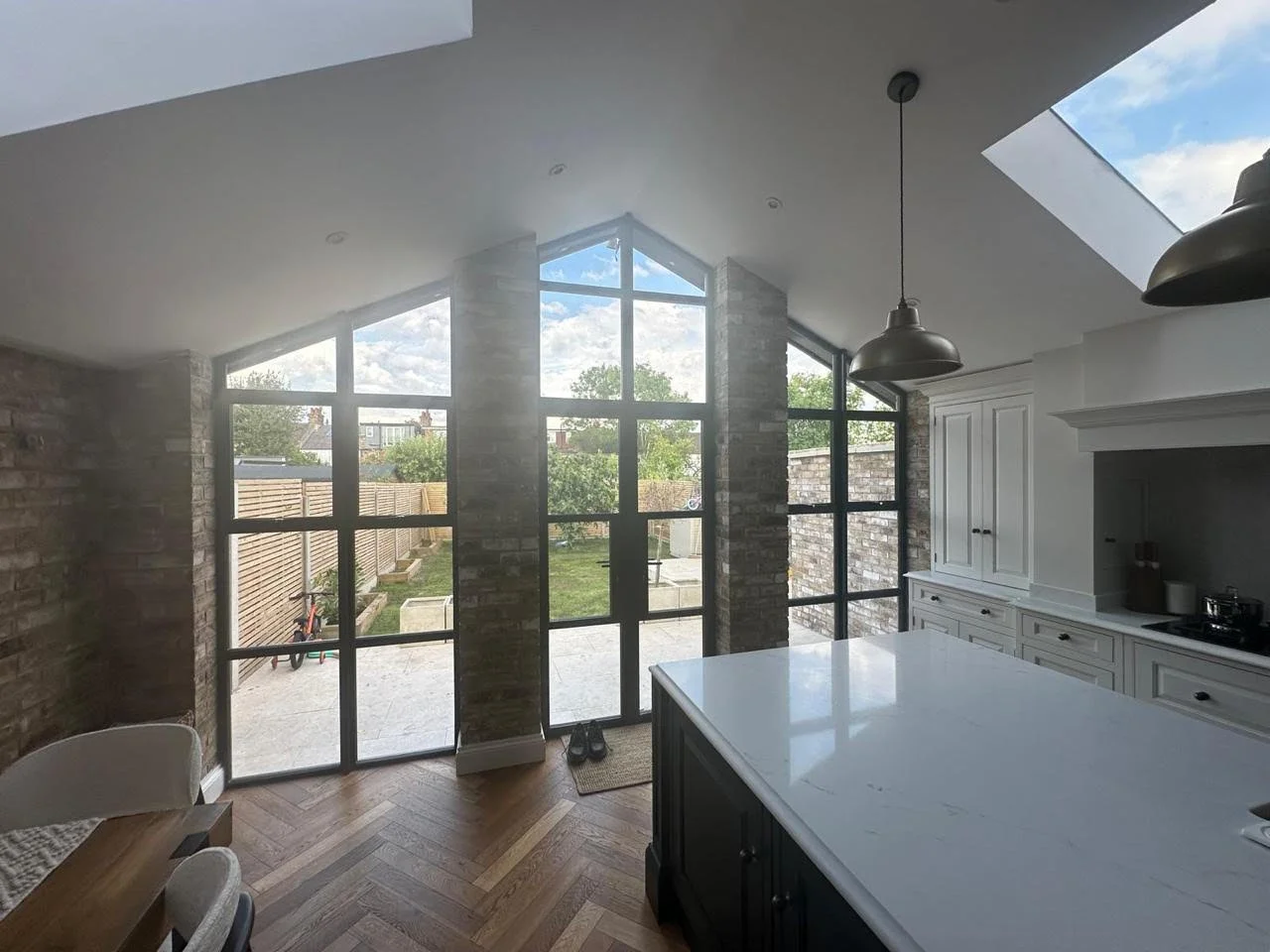
But numbers only tell half the story. Walk into a well-designed rear extension on a London terrace and you feel the difference before you see the data. The kitchen is flooded with natural light. The garden is no longer something you look at through a small window; it is part of the room. Breakfast happens at an island with space for the whole family. For a young professional couple, that open-plan ground floor is the reason they chose the property. For a growing family, it is the reason they stayed instead of spending £40,000 to move. An extension is one of the few ways to unlock more from what you already own without re-entering a market where every purchase comes with six figures of competition and compromise.

Four Types of Extension, Four Very Different Returns
Every extension conversation in London comes down to four options: go out the back, go into the loft, fill in the side return, or dig down. Each has a different cost profile, planning route, and return on investment.
Ranges reflect London-specific pricing. Costs are construction only, excluding professional fees and VAT.
Loft Conversions: The Highest Return per Pound Spent
The loft conversion remains the single best-returning extension type in London. A standard dormer on a Victorian or Edwardian terrace costs £50,000 to £70,000 in outer London boroughs and £70,000 to £120,000 in inner London, depending on specification and complexity. Mansard conversions, common in conservation areas where dormer windows face restrictions, sit at the higher end.
The return? Inner London loft conversions consistently add 20 to 25% to property values; outer boroughs see 15 to 18%. On a £500,000 terrace in Lewisham, a £60,000 dormer with an en-suite could add £100,000 to £125,000: roughly £1.70 to £2.00 for every £1 spent.
Why does the loft outperform? It adds floor space and changes the bedroom count simultaneously. A three-bed terrace and a four-bed terrace are not the same product. They attract different buyers, qualify for different mortgage brackets, and command different prices.
The bedroom count effect: Nationwide's data shows that going from 2-bed to 3-bed adds 13% on a terrace and 17% on a semi. Going from 3-bed to 4-bed adds 10-12%. The loft captures this premium because it adds both a bedroom and (typically) a bathroom, hitting two value drivers simultaneously.
Rear Extensions: The Most Common, Not Always the Most Valuable
The single-storey rear extension is London's most popular home improvement, and the one most likely to disappoint on return if not thought through properly.
A typical rear extension adds 25 to 35 sqm and costs £70,000 to £120,000 at a good specification (£3,000 to £5,000 per sqm). With underfloor heating, bi-fold doors, and quality finishes, expect £4,000+ per sqm.
Value added: 10 to 15%. On a £500,000 home, that is £50,000 to £75,000. A £90,000 extension adding £65,000 is a net loss on paper, though many homeowners recoup the difference in lifestyle value before selling. The key: an open-plan kitchen-diner that connects to the garden will outperform a basic box extension every time. The design drives the return.
Side Return Extensions: Small Footprint, Outsized Impact
That narrow strip of dead space running alongside the kitchen, typically 1.2 metres wide and 4 to 5 metres deep, is worth almost nothing as an alleyway. Fill it in, and you transform a cramped galley kitchen into a bright, open-plan space.
A typical side return is around 12 sqm and costs £55,000 to £85,000 (~£5,000/sqm), higher per metre than a rear extension because the structural work (opening up the side wall, steel beams, party wall) is disproportionate to the floor area gained.
The return: 10 to 20% of property value. In Kensington and Chelsea, where residential space sells for £18,000+ per sqm, side returns on the highest-value streets have been linked to six-figure uplifts. In Wandsworth or Hackney, a £70,000 side return can add £80,000 to £130,000.
Basements: The Most Expensive, the Most Complex
Basements cost roughly double what an above-ground extension costs per square metre, take 9 to 15 months, and require specialist contractors, structural engineers, and often party wall agreements with multiple neighbours.
Construction starts at £6,000 per sqm plus VAT for a standard terraced house, reaching £10,000 per sqm on complex sites. A 40 sqm basement could cost £240,000 to £400,000 once you add professional fees, party wall agreements, and contingency.
The value side: in west and central London, residential space is valued at £8,000 to £20,000 per sqm. A 40 sqm basement where space sells for £12,000/sqm creates £480,000 of value on a build of perhaps £300,000. In outer boroughs where space sells for £4,500 to £6,000/sqm, the maths rarely works. A basement is a prime London play, not a universal strategy.
Where You Build Matters More Than What You Build
The single biggest variable in whether your extension makes financial sense is not the type you choose. It is the borough you live in.
Build costs vary modestly across London. A single-storey extension in Croydon costs roughly 5 to 10% less than the same extension in Islington. Property values vary enormously. A square metre in Kensington is worth £18,000 to £30,000. In Croydon, £4,500 to £7,000. That four-to-one ratio means the same project generates wildly different outcomes depending on postcode.
| Borough | Avg. House Price | Price/sqm | Build Cost/sqm | ROI Signal |
|---|---|---|---|---|
| Kensington & Chelsea | £1,190,000 | £18,000+ | £3,500-£5,000 | Strong |
| Wandsworth | £658,000 | £8,000-£13,000 | £3,200-£4,500 | Strong |
| Hackney | £634,000 | £8,000-£12,000 | £3,200-£4,500 | Strong |
| Lewisham | £463,000 | £6,000-£9,000 | £3,000-£4,000 | Good |
| Ealing | £537,000 | £6,000-£9,000 | £3,000-£4,200 | Good |
| Bromley | £509,000 | £5,500-£8,000 | £2,800-£3,800 | Good |
| Waltham Forest | £528,000 | £6,000-£7,500 | £2,800-£3,800 | Good |
| Enfield | £482,000 | £5,000-£6,500 | £2,800-£3,800 | Good |
| Croydon | £410,000 | £4,500-£7,000 | £2,750-£3,500 | Good |
| Barking & Dagenham | £355,000 | £4,500-£6,000 | £2,750-£3,500 | Marginal |
Sources: HM Land Registry UK House Price Index (Jan 2026), ONS, Investropa, Plumplot, Architecture for London, Rise Design Studio. Build costs reflect good-quality single-storey specification. Price/sqm ranges reflect typical residential property; prime streets within each borough may exceed these ranges.
In Kensington, Wandsworth, and Hackney, the gap between build cost (£3,200-£5,000/sqm) and property value (£8,000-£18,000+/sqm) is enormous. Every square metre creates significant net value. In Barking and Dagenham, the gap narrows and the margin for error is thin.
This does not mean extensions are a bad idea in outer boroughs. It means the type of extension matters more. A loft conversion that adds a bedroom and changes the property's market bracket is worthwhile almost anywhere in London. A speculative basement dig in a borough where space sells for £5,000/sqm is almost never worthwhile.
Where We See Opportunity Right Now
The table shows the current maths, but property markets move. The boroughs where extension ROI is strongest today are not necessarily the ones that will lead in two to three years.
Boroughs positioned to capitalise now. Lewisham (+3.7% annual growth, December 2025) and Waltham Forest (+3.3%) are outperforming London as a whole, which recorded a 1.0% decline over the same period. Lewisham in particular has a compelling combination: property values high enough to justify extension costs, build-cost-to-value ratios that generate strong returns, and a growth trajectory driven by DLR connectivity, ongoing regeneration, and the long-discussed Bakerloo line extension. Bromley (+6.8%) and Havering (+5.4%) are growing even faster, but their lower price-per-sqm means the extension maths only works convincingly for loft conversions that trigger bedroom premiums.
Boroughs to watch in the next two to three years. The Elizabeth Line continues to reshape values along its corridor. Woolwich and Abbey Wood have seen 6 to 8% annual growth since the line opened, and areas like Ealing Broadway are approaching 9%. Tottenham and Stratford are forecast for 3 to 6% growth in 2026 as regeneration investment translates into buyer demand. Savills forecasts London-wide prices at roughly flat for 2026, but with cumulative growth of around 13.6% expected between 2026 and 2030, the outer and mid-priced boroughs where affordability still works for first-time buyers are likely to lead that recovery.
The counter-argument. Prime central London (Westminster, Kensington and Chelsea) recorded significant price falls in 2025, down 11 to 15% year-on-year. If you own in a prime borough that has corrected, extending now locks in value at today's lower base and positions the property for recovery. The risk is that prime recovery is slower than forecast. But extensions in prime London generate the highest absolute returns per sqm because the gap between build cost and space value is widest. For homeowners already in these boroughs, the case for extending rather than selling into a depressed market is arguably stronger than ever.
Sources: HM Land Registry UK House Price Index (Dec 2025), Savills UK Residential Forecast 2026-2030, Investropa London Price Forecasts 2026, CBRE London Borough by Borough Report 2025.
Bedrooms, Studies, and the £50,000 Question
Should the new space be a bedroom or a home office? The instinct is to build a study. The data says otherwise.
uplift only
premium captured
Source: Nationwide Building Society. A study adds general floor space value (10% more space = 5% more value). A bedroom triggers the bedroom-count premium, which is 2-3x more valuable per sqm.
A 10% increase in floor space adds 5% regardless of configuration. But configuring that same space as a bedroom adds 13% (terraced) to 17% (semi-detached) because it triggers the bedroom-count premium: roughly two to three times more per square metre than a study or playroom.
The caveat: a room only counts as a bedroom if it meets minimum size requirements (a double must be at least 11.5 sqm under the Housing Act) with a window and adequate ceiling height. A loft room with restricted headroom marketed as a "bedroom" will not attract the same premium as a properly configured double.
If your extension can deliver a genuine double bedroom, make it a bedroom. Use it as an office day-to-day, but when you sell, the bedroom count drives the price.
What It Actually Costs to Build in London Right Now
London extensions cost 25 to 40% more than the national average: higher labour rates, constrained sites, and tighter planning requirements.
Sources: Architecture for London, Rise Design Studio, My Architect, Multiply.build. Costs are construction only. Professional fees and VAT are additional.
These are construction costs only. On top: professional fees (architectural drawings, structural calculations, planning), building control, and party wall costs if you share a boundary. The total is always more than the builder's quote alone. For current build costs and to connect with vetted contractors, see the Builder Hub, a trusted and vetted builders network helping you find the right builder at the best price.
The hidden cost: The Building Cost Information Service (BCIS), the UK construction industry's benchmark data provider, forecasts building costs to increase by 14% over the next five years, with tender prices rising 15%. If you are considering an extension, the cost of waiting is real. A project quoted at £100,000 today could cost £114,000 by 2031.
Two Properties, Two Strategies, Two Very Different Outcomes
The data above tells you what is possible in theory. These two examples show what it looks like in practice, with real London boroughs, real costs, and real value outcomes.
Case Study 1: Stay and Develop (Waltham Forest, E4)
A three-bed, one-bath Victorian terrace in E4, valued at £550,000. The family has outgrown it. The third bedroom doubles as a home office. Mornings are a queue for the single bathroom. The kitchen is a narrow galley that turns its back on the garden. The question every family in this position asks: do we move, or do we make this house work?
Moving to a four-bed, two-bath in the same area costs £720,000 to £780,000. That means a £200,000 bigger mortgage, plus stamp duty at £23,500, estate agent fees, solicitors, surveys, and removals. Total transaction costs: roughly £36,000 to £38,000. Every penny of that is dead money. It creates zero equity. You simply pay it to leave.
The alternative: a rear extension to create the open-plan kitchen-diner the family actually uses, combined with a dormer loft conversion for a fourth bedroom and en-suite. Two projects, one transformation. The ground floor becomes a bright, functional space that connects to the garden. The loft adds the bedroom and bathroom that moves the property into a completely different market bracket.
Based on Nationwide's up to 24% uplift (loft + en-suite on a 3-bed/1-bath) and 10-15% rear extension value applied sequentially. Waltham Forest avg. house price: £528,000 (Land Registry, Jan 2026). 4-bed/2-bath terraced comps: £700,000-£780,000+ (Rightmove, 2026).
The maths are clear. Extending costs £125,000 to £158,000 and the value uplift ranges from £150,000 to £200,000. At conservative estimates, the project roughly breaks even. At realistic mid-range figures, it creates £25,000 to £50,000 in net equity, and the extensions have effectively paid for themselves. Moving costs £36,000+ in transaction fees, requires a £200,000 bigger mortgage, and creates nothing.
But the real value goes beyond the spreadsheet. The family stays in the school catchment. They keep the neighbours they know, the commute that works, the GP surgery that already has their records. They get an open-plan kitchen that works for weeknight dinners and weekend entertaining, a fourth bedroom so each child has their own space, and an en-suite that ends the morning queue. They built exactly the home they needed, in the place they already chose to live.
The Refinance Option
There is another angle that most homeowners overlook. Once the extensions are complete and the property has been revalued, you can refinance at the new, higher value and release a significant portion of the capital you invested.
On this property, a remortgage at 75% loan-to-value on the new valuation of £700,000 to £750,000 gives a new mortgage of £525,000 to £562,500. If the existing mortgage was £350,000 (a typical 64% LTV on the original £550,000), that releases £175,000 to £212,500 in cash. That is more than the entire cost of the extensions. The family has improved their home, created equity, and pulled their capital back out, ready for the next move, whether that is an investment property, school fees, or simply financial security.
Case Study 2: Maximum Yield (Enfield)
A two-bed, one-bath Victorian terrace in Enfield, purchased for £350,000, renting at £1,500 per month. The investor has capital to deploy. The question: extend the existing property or use the same money as a deposit on a second buy-to-let? The answer comes down to two numbers: additional monthly income and stamp duty.
The development plan: a full mansard loft conversion adding two bedrooms and a bathroom (~28 sqm), combined with a rear extension (~20 sqm) for an open-plan kitchen-diner. This is not a light refurbishment. This turns a dated two-bed into a modern four-bed, two-bath family home with an open-plan ground floor. It moves the property across two bedroom-count brackets and into a completely different rental and resale market.
The mansard requires planning permission, not permitted development. That means 8 to 12 weeks of additional time and a planning fee. But a mansard delivers 25 to 35 sqm of usable loft space versus 12 to 15 sqm from a standard dormer under PD. That additional space is exactly what makes a two-bedroom loft conversion possible, and it is the difference between a three-bed and a four-bed outcome.
Based on Nationwide's 13% bedroom premium (2-bed to 3-bed terrace), 10% uplift (3-bed to 4-bed), 6% bathroom premium, and 10-15% rear extension value applied sequentially. Enfield avg. house price: £482,000 (Land Registry, Jan 2026). Rental data: Rightmove, ONS, 2025-2026.
The rental uplift is where this development earns its keep: £900 to £1,100 per month in additional income, or £10,800 to £13,200 per year. Over ten years, the extensions pay for themselves through the rental premium alone, and the investor holds a four-bed asset that has appreciated in both value and desirability.
Now compare that to using the same £130,000 as a deposit on a second buy-to-let at £350,000. Since October 2024, the stamp duty surcharge on additional dwellings is 5%, meaning £22,500 in stamp duty on a £350,000 purchase before you have collected a single month of rent. The mortgage on the remaining £220,000 at current buy-to-let rates (5.5 to 6.0%) costs roughly £1,000 to £1,100 per month in interest. The second property rents at £1,500. Net monthly income after mortgage: roughly £400 to £500. You now have two properties to manage, two sets of voids risk, two insurance policies, and a £22,500 stamp duty bill that bought you nothing.
The extension route delivers roughly double the additional monthly income, avoids £22,500 in stamp duty entirely, carries no new mortgage, and concentrates your portfolio in a single, higher-quality asset. One property, fully under your control, generating more income with less risk.
The Investor Refinance: Recycle, Repeat
Here is where the numbers become genuinely powerful. Once the extensions are complete and the property is revalued, the investor refinances at the new, higher value and pulls their development capital back out.
A remortgage at 75% LTV on the new valuation of £500,000 to £530,000 gives a new mortgage of £375,000 to £397,500. If the original purchase was at 75% LTV (mortgage of £262,500 on the £350,000 purchase), that releases £112,500 to £135,000 in cash. The extensions cost £127,000 to £158,000, so the investor recovers most or all of the development spend through the refinance.
After refinancing, the investor holds a four-bed, two-bath property worth £500,000 to £530,000, renting at £2,400 to £2,600 per month, with their original capital largely returned. That capital is now free to fund the next development. This is the cycle that builds a portfolio: buy, extend, refinance, rent, repeat. Each cycle creates equity, increases rental income, and recycles the capital for the next project. For investors already holding London property, the best next move is often not buying again. It is making what you already own worth more, then using the unlocked equity to do it again. For investors considering HMO conversions as part of this strategy, our research on HMO conversion demand covers the rental yield and regulatory picture in detail.
The Planning Question: Permitted Development vs. Planning Permission
Most homeowners assume permitted development (PD) is the ideal route: no application, no waiting, no risk of refusal. For straightforward projects, it often is. But here is what most guides do not tell you: the biggest value plays in residential extensions almost always require planning permission, and the data suggests the extra time and cost are well worth it.
What You Can Do Without Permission
Single-storey rear extensions under PD: up to 4 metres from the rear wall for detached houses (8 metres with prior approval), 3 metres for semi-detached and terraced (6 metres with prior approval). Maximum 4 metres in height; eaves capped at 3 metres within 2 metres of a boundary.
Loft conversions under PD: up to 40 cubic metres additional roof space on a terraced house, 50 cubic metres on detached or semi-detached. Rear dormers are generally fine; front dormers almost always require planning permission.
PD is faster and removes uncertainty. For a standard rear dormer on a Victorian terrace, it is often the right choice. But PD comes with strict size caps, and those caps limit how much value you can create.
Why Planning Permission Is Often the Smarter Play
Consider the loft. A standard rear dormer under PD gives you roughly 12 to 15 sqm of usable floor space. A mansard conversion, which almost always requires planning permission, delivers 25 to 35 sqm. On a London terrace, the difference is between a tight loft bedroom and a full additional floor with a bedroom, en-suite, and storage. The value difference is proportional.
Planning permission also unlocks wraparound extensions (rear plus side return in one design), two-storey rears, front dormers, and creative configurations that PD does not allow. These are the projects that transform a property, not just extend it.
The cost? A householder planning application is £548 and typically takes 8 weeks for a decision. The approval rate is 90% for householder applications across England, with 93% decided within the statutory timeframe (GOV.UK, year ending December 2025). When the drawings are properly prepared and the design respects the local context, the odds are strongly in your favour.
The real question is not "can I avoid planning permission?" It is "what is the maximum I can achieve with my property, and which route gets me there?" For a borough-by-borough breakdown of approval rates and the specific reasons applications get refused, see our research on what actually gets approved in London.
What Always Needs Planning Permission
Basements always require a full planning application. Side return extensions typically need planning permission, with approval rates of 85 to 90% when properly designed. Mansard loft conversions, two-storey extensions, and any work in a conservation area or Article 4 direction zone will also need an application.
Conservation Areas
London has more conservation areas than any other UK city. If your property sits in one, PD rights are significantly curtailed or removed entirely. This is not a reason to scale back. Conservation area applications are approved regularly when the design is sensitive to the character of the area. A proper feasibility assessment before committing to a design is the difference between a smooth approval and a costly refusal.
Timelines are indicative for a typical London residential project. Basements follow a significantly longer programme.
The Extension Decision Framework
Before you spend a penny, answer these five questions.
1. What is your space worth per square metre?
Look up recent sold prices on your street (free at landregistry.data.gov.uk) and divide by the property's floor area (available on the EPC register). Above £6,000/sqm, most extensions generate positive returns. Above £10,000/sqm, the maths becomes very compelling.
2. Will the extension change your property's bedroom count?
If yes, you capture the bedroom-count premium (13-17% on top of the base floor-area uplift). This is the single biggest value lever. If your extension adds living space but not a bedroom, your return is limited to the general 5% per 10% floor area increase.
3. What is the planning route?
PD is faster and more certain, but it caps what you can build. If planning permission lets you achieve significantly more (a mansard instead of a dormer, a wraparound instead of a basic rear), the 8 weeks and £548 application fee are a small price for the additional value.
4. What is the total cost, not just the build cost?
Construction is typically only 60% of the total spend. Professional fees, building control, and contingency all sit on top. The case studies above show exactly how these stack up. For a clearer picture of current build costs, see the Builder Hub, a trusted and vetted builders network helping you find the right builder at the best price.
5. How long do you plan to stay?
If you are selling within two years, the extension needs to generate a clear financial return. If you are staying for ten years, the lifestyle value matters as much as the financial return, and even a project that breaks even on paper can be worthwhile for the quality of life it delivers.
Extensions remain one of the strongest financial moves a London homeowner can make, but only when driven by data rather than instinct. Loft conversions deliver the best pound-for-pound return in almost every borough. Side returns punch above their weight on terraced properties. Rear extensions are the safest option but rarely the most profitable unless they transform the ground floor. Basements are a prime London strategy that makes limited sense below £8,000/sqm.
The bedroom-count premium remains the most underused lever in residential property. If your extension can add a genuine double bedroom with an en-suite, it is worth two to three times more than the same floor area as a study or playroom.
The smartest thing you can do before committing is get a proper feasibility assessment. Not a builder's quote. Not a kitchen showroom design. A clear-eyed analysis of what your property can accommodate, what planning will allow, and what the numbers look like when you factor in every cost.
At Bashkal, feasibility is what we do. Send us your postcode and what you are thinking, and we will tell you what is possible, what it is likely to cost, and whether the numbers make sense for your property. Get in touch for a free consultation: info@bashkal.com or call 020 3740 7041.
Sources
Bedrooms, Bathrooms and Extensions: What Adds Value to Your Home?, Nationwide Building Society, 2025
UK House Price Index, HM Land Registry, January 2026
House Extension Costs in London 2026, Architecture for London, 2026
The Real Cost of a House Extension in London in 2026, Rise Design Studio, 2026
Basement Construction Costs in London (2026 Update), Architecture for London, 2026
London Extension Costs 2025: Real Data from 5,000+ Projects, Multiply.build, 2025
Side Return Extension London: Cost Guide 2025, Multiply.build, 2025
Side Return Extension London: Costs 2026, Mayfair Studio, 2026
Average Property Price Per Sqm in London, Investropa, June 2025
Permitted Development Extensions 2026, DeVis Architecture, 2026
BCIS Construction Industry Forecast, RICS, 2026
What Is Happening to Build Costs?, Savills, 2025
Property Price Forecasts London (2026), Investropa, 2026
London Borough by Borough 2025, CBRE UK Residential, 2025
UK House Price Index England: December 2025, HM Land Registry, 2025
Planning Applications in England: October to December 2025, DLUHC, 2025